
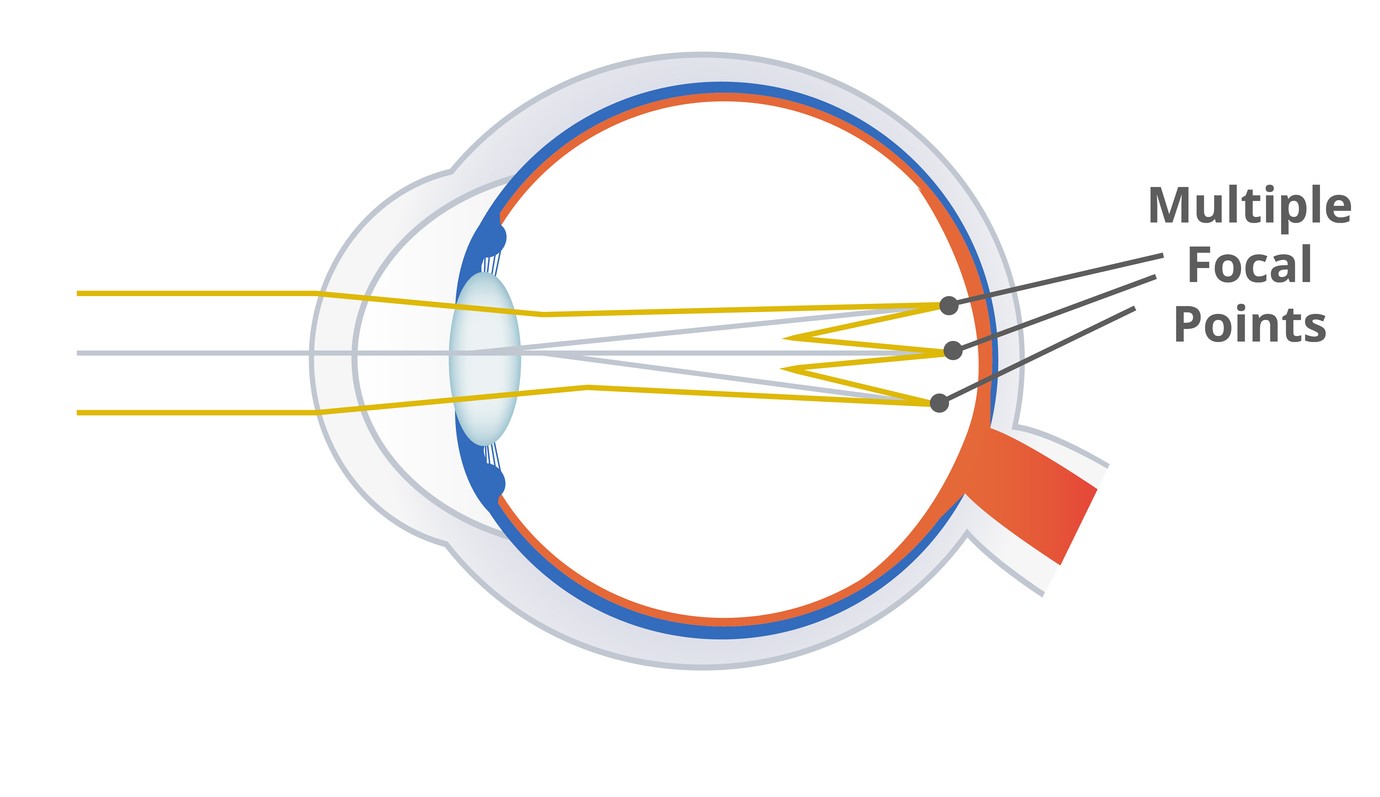
What is astigmatism?
In an astigmatic eye, the image is formed differently depending on the meridians.
There is a meridian of maximum power and a meridian of minimum power, between which the power varies continuously. Different combinations are possible: the astigmatic eye may be myopic or hyperopic in one meridian and without refractive error in the other (simple astigmatism); myopic or hyperopic in all meridians (compound astigmatism); or myopic in one meridian and hyperopic in the other (mixed astigmatism). The astigmatic eye often has an oval-shaped cornea rather than a round one. People with astigmatism often have imprecise vision at any distance and do not clearly perceive contrasts between horizontal, vertical, or oblique lines.
The principle of astigmatism correction is:
- Either placing a toric lens or contact lens in front of the eye, with power that varies by meridian in the opposite way to the eye’s astigmatism.
- Or modifying the curvature of the cornea using a laser to harmonize the eye’s optical power. This is the principle of the (excimer) laser used in PRK or LASIK procedures.
- Or implanting a lens inside the eye (intraocular lens, a technique mainly used for high corrections that do not allow laser reshaping of the cornea).
Book an appointment with your ophthalmologist in Uccle
If your vision seems blurry, don’t wait—book an appointment with me.