
This page covers visual defects, also known as refractive errors. Feel free to also visit the page dedicated to each specific condition.
What is refraction?
“An optical phenomenon by which the direction of light changes when it passes from one transparent medium to another with a different optical density.”
In the context of vision, refraction is a key concept that describes how light is bent as it passes through the different structures of the eye (the cornea and the lens) in order to focus on the retina.
The cornea provides most of the eye’s refractive power, while the lens fine-tunes the focus (accommodation) to allow clear vision at different distances.
Refractive disorders occur when light is not properly focused on the retina.
Understanding and correcting refraction are essential in ophthalmology to diagnose and treat vision disorders, whether through glasses, contact lenses, or refractive surgery.
In a normal eye (without refractive error), the image of a distant object (located at infinity) is formed on the retina. Light rays, refracted by the cornea and the lens, converge on the retina to produce a sharp image. The optical power of the anterior part of the eye (cornea and lens) is perfectly matched to the length of the eye.
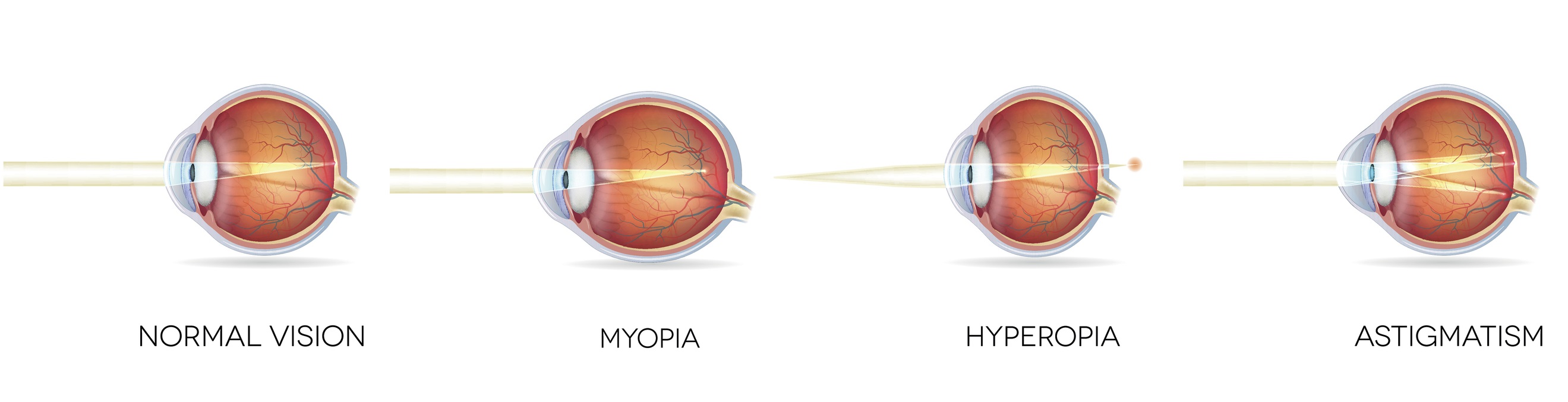
When the eye has a refractive error, the image of a distant object is formed either in front of or behind the retina, resulting in blurred vision. There is a mismatch between the refractive power of the eye and its length.
The different vision disorders

Myopia

Hyperopia

Astigmatism