
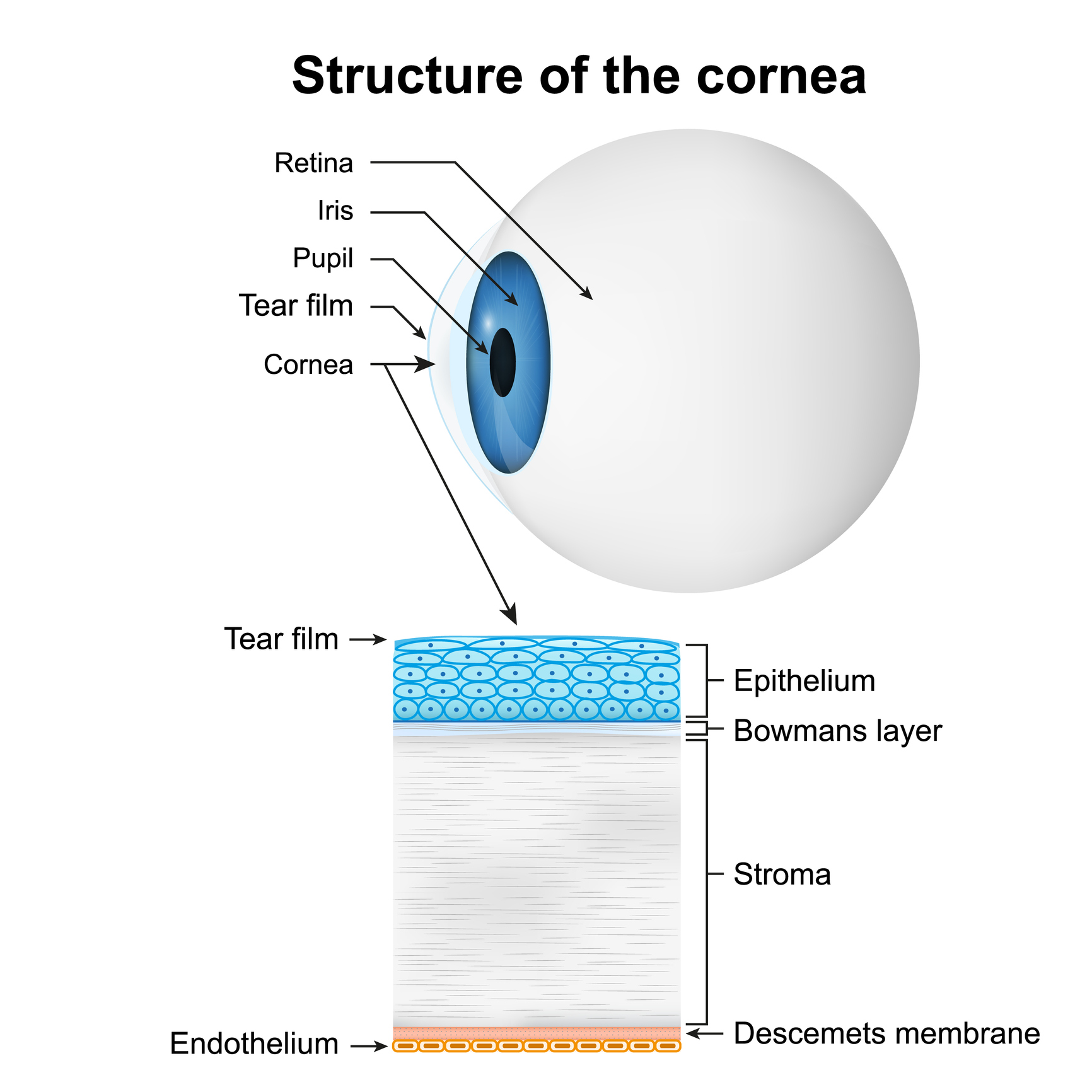
The principle of the PRK technique for eye surgery
PRK is based on delivering refractive correction to the surface of the cornea. It does not require cutting into the cornea, unlike LASIK.
The structure of the cornea can be compared to the skin. It is made up of two main layers: the epithelium on the surface (equivalent to the epidermis of the skin) and the stroma beneath (similar to the dermis). During PRK, the epithelium is separated from the underlying stroma and then removed. The correction is applied to the stroma located just beneath the corneal epithelium. The epithelium naturally grows back within a few days to cover the surface of the cornea.
The epithelium is removed (peeled) either manually or using a laser (Trans-PRK). The choice between manual or laser removal depends on the surgeon’s preference. There is no difference in terms of visual outcome.
The principle of refractive correction with PRK is similar to LASIK, as both techniques use the same excimer laser to modify the curvature of the cornea and change its optical power. The main difference between PRK and LASIK lies in the removal of the epithelium and the absence of a corneal flap in PRK.
The correction is applied to the surface of the stroma located just beneath the corneal epithelium. It is therefore a surface laser procedure. In LASIK, a flap consisting of the epithelium and part of the stroma is created. The flap is lifted and then repositioned. The laser correction is therefore delivered to the stroma at a deeper level.
How PRK laser eye surgery is performed
Completely painless, PRK is quick and takes less than ten minutes per eye. Most of the operative time is devoted to preparation for the corrective laser, which lasts only a few seconds.
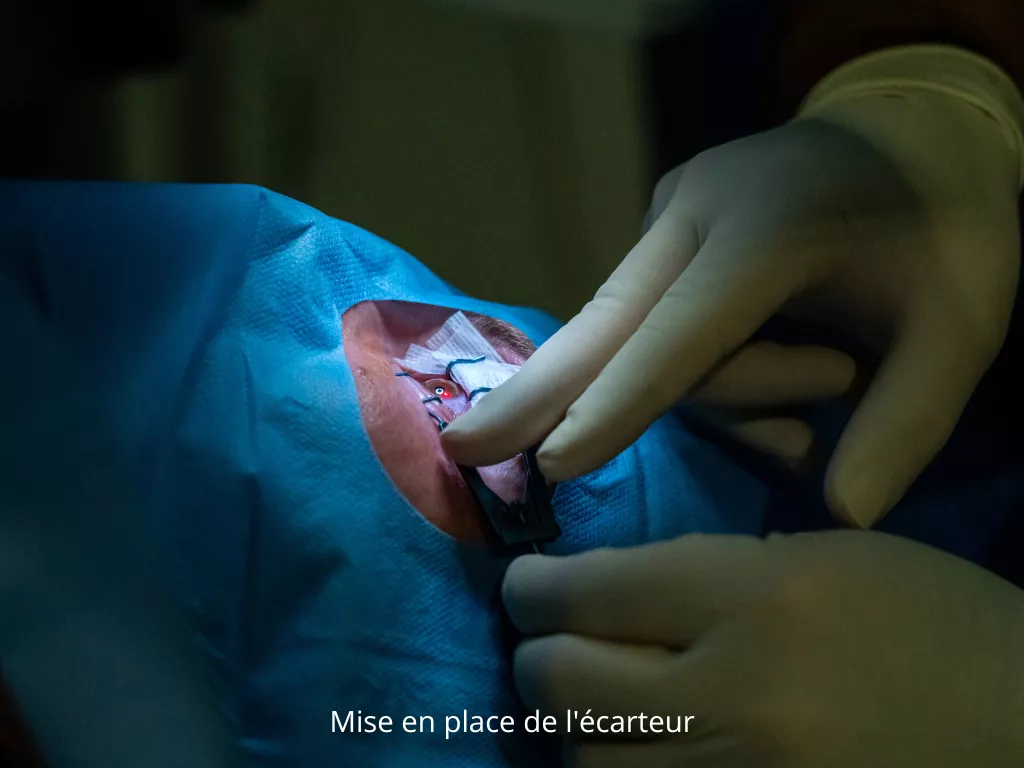
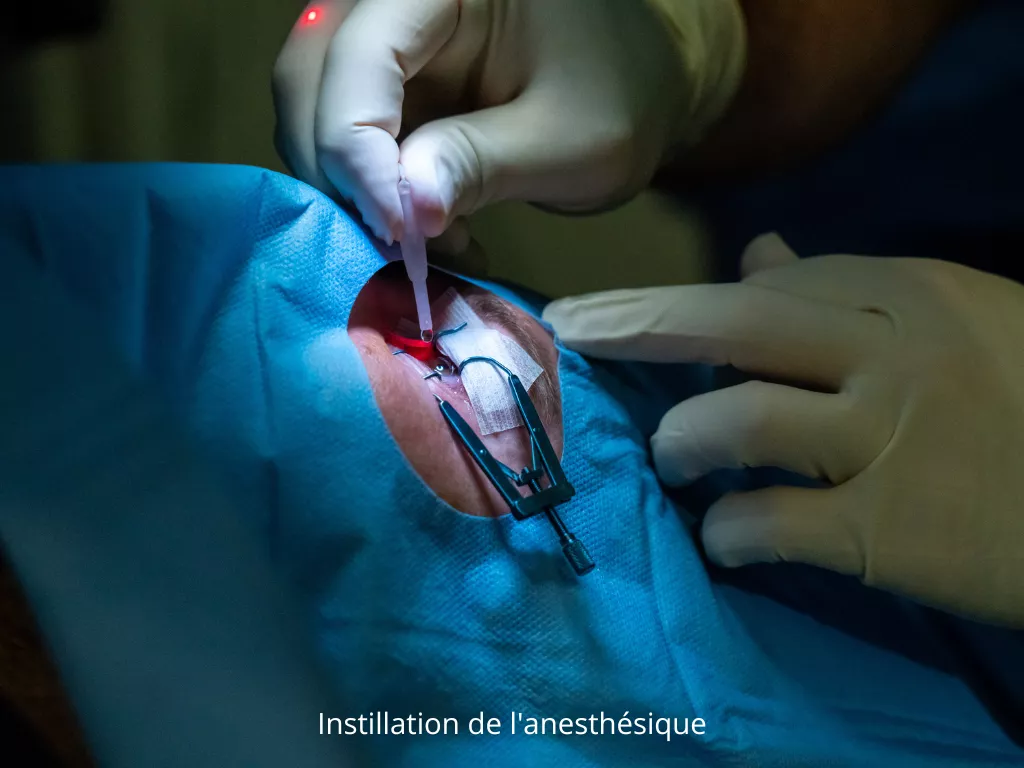
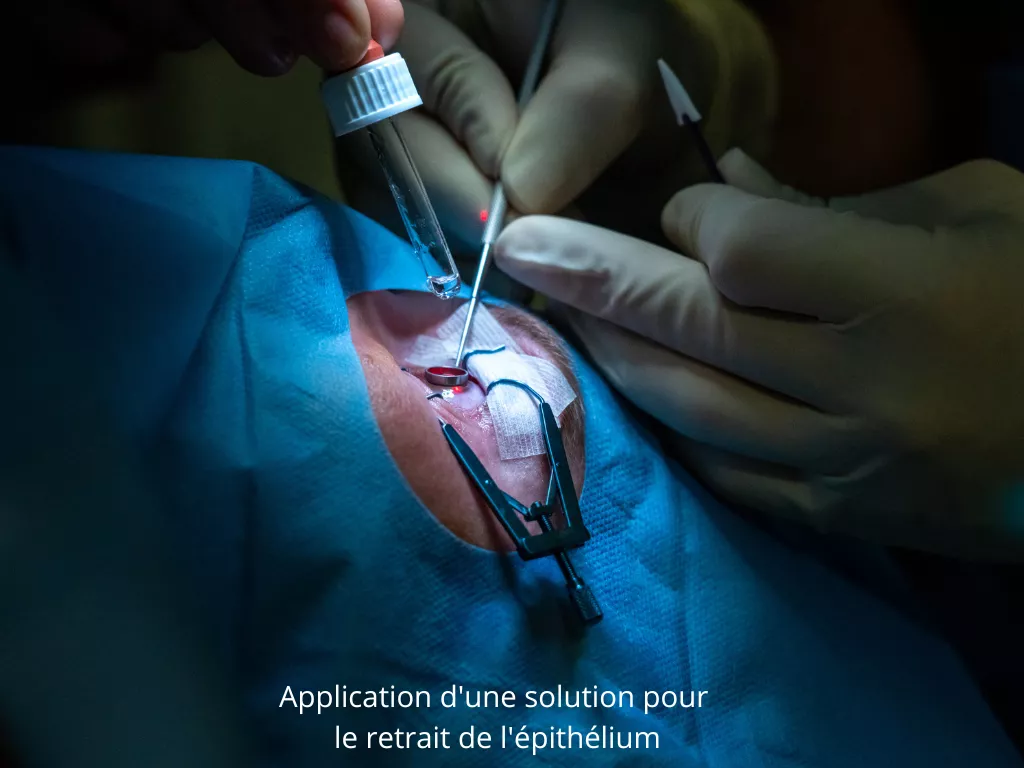
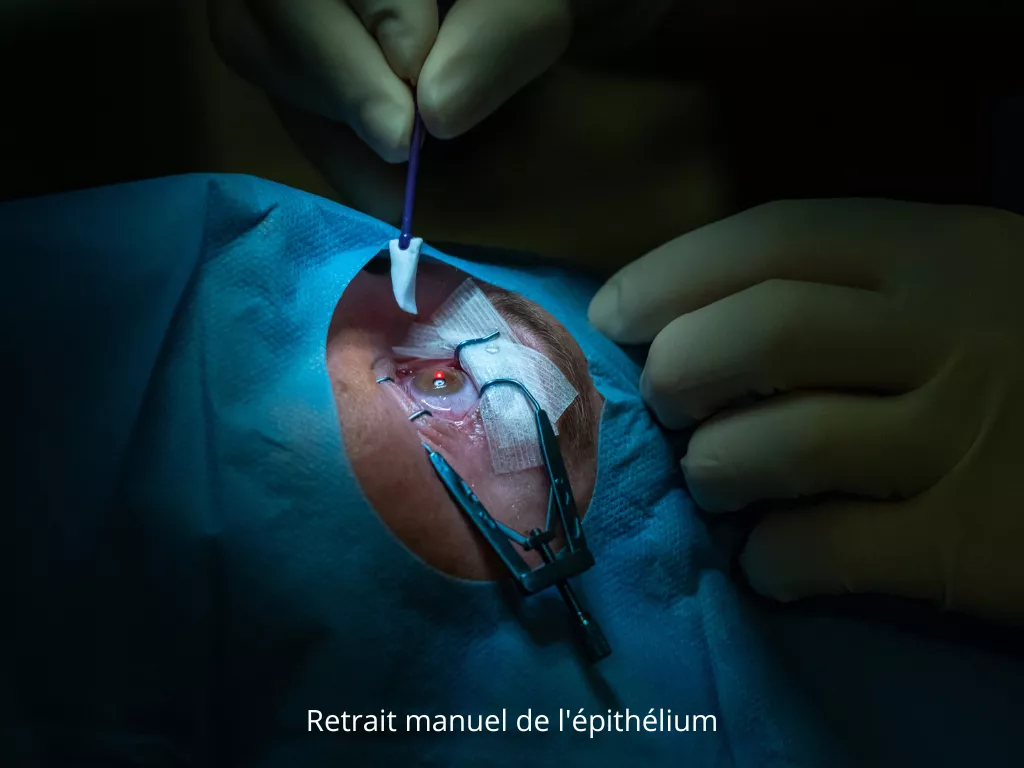
First, the eye is anesthetized with eye drops. Then, an eyelid speculum is placed to prevent blinking during the procedure. The epithelium is removed either manually or with a laser in order to expose the corneal stroma. This step is completely painless.
The patient is then asked to fixate on a light target while the laser delivers the correction of the visual defect. This step, also painless, is performed under the control of an “eye tracker.” This system tracks the eye during surgery and instantly and automatically directs the laser beam to its target in case of eye movement. It ensures proper centration of the treatment, which is essential for accurate correction.
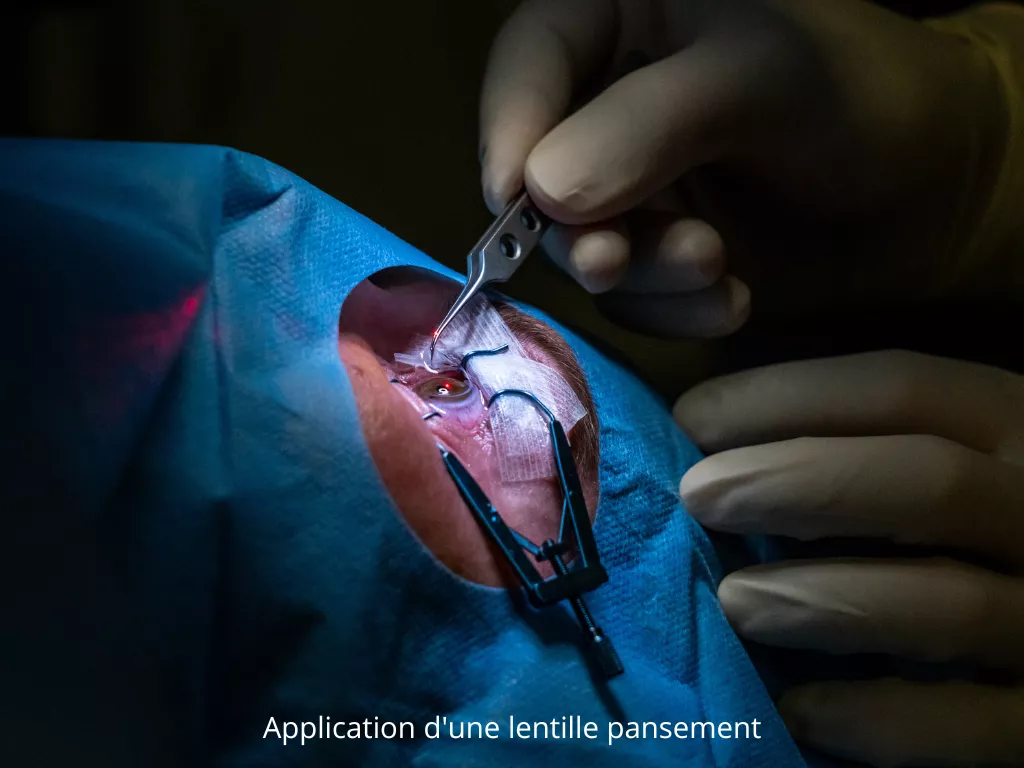
After the application of a diluted mitomycin solution (to prevent the occurrence of haze), a non-corrective contact lens (“bandage” lens) is placed. It will be removed during a follow-up visit 4 to 5 days later.
The patient can leave the surgical center immediately wearing protective sunglasses.
The steps of PRK
Post-operative recovery after PRK eye surgery
Post-operative pain usually begins about one hour after the procedure and lasts for 48 to 72 hours. For most patients, pain is mainly experienced on the first day and then gives way to discomfort (a gritty sensation in the eyes and sensitivity to light). Painkillers can be taken to relieve the discomfort.
Although vision improves immediately, it remains blurred due to the removal of the epithelium. Visual recovery progresses rapidly from the first week as the epithelium regenerates.
Post-operative treatment consists of using anti-inflammatory and antibiotic eye drops for three weeks.
The “bandage” contact lens is removed 4 to 5 days after surgery. Returning to work or sports activities is possible after one week. Eye makeup and swimming are allowed after 15 days.
The eyes must be protected from UV rays, and sunglasses should be worn outdoors (in sunny conditions) during the first month.
Vision continues to improve over the first few weeks and stabilizes after one month.
Side effects and complications related to laser eye surgery
Side effects are common to both PRK and LASIK. They are rare and most often temporary:
Dry eye requiring the use of artificial tears. Dry eye is much more pronounced after LASIK due to the creation of the corneal flap.
The perception of light halos, a tendency to glare, and discomfort with night vision. These symptoms generally regress within the first few months.
Complications after PRK are very rare but may nevertheless require re-intervention and lead to a reduction in visual acuity:
Infection or inflammation: exceptional, they are prevented by the post-operative use of antibiotic and anti-inflammatory eye drops.
Abnormal healing that may lead to corneal opacity. Known as “haze,” this complication has become very rare thanks to the latest-generation excimer lasers and, above all, the preventive application of mitomycin during surgery. The use of anti-inflammatory drops and UV protection further reduces its incidence. If it does occur despite these measures, administering anti-inflammatory eye drops for a few months can restore corneal transparency.
Possibility of enhancement after laser eye surgery
Even though results are excellent, they can never be guaranteed 100% (due to the healing process). However, a surgical enhancement can be performed after a few months if necessary.
Although the effects are stable over time, a re-intervention is possible even years after the procedure (in case of regression of the correction or the onset of presbyopia).
Let’s talk together about PRK surgery
This procedure can be explained in a simple and personalized way. If you are considering laser eye surgery, I suggest discussing it during an initial consultation.
Vos questions sur l'opération PKR
Quelle est la différence entre la PKR et le LASIK ?
La PKR et le LASIK utilisent le même laser excimer pour modifier la courbure de la cornée, mais leur approche diffère :
- PKR : retrait de l'épithélium et correction délivrée à la surface de la cornée, sans découpe. Idéale pour les cornées fines, les yeux secs ou les sportifs de contact.
- LASIK : découpe d'un capot cornéen et correction en profondeur. Récupération visuelle plus rapide.
Le résultat visuel final est équivalent. Le choix dépend de votre profil oculaire et de votre mode de vie.
L'opération PKR est-elle douloureuse ?
L'intervention en elle-même est totalement indolore grâce à une anesthésie par gouttes. Un sédatif léger peut être proposé pour favoriser la détente.
En revanche, des douleurs apparaissent environ une heure après l'opération et durent 48 à 72 heures, surtout le premier jour. Elles sont efficacement soulagées par des comprimés antidouleur, puis laissent place à une simple gêne (sensation de grains de sable, sensibilité à la lumière).
Quel est le temps de récupération après une PKR ?
La récupération est progressive :
- Jours 1 à 3 : douleurs et vision encore floue
- Jours 4-5 : retrait de la lentille pansement en consultation
- Semaine 1 : reprise du travail possible, vision en amélioration rapide
- Après 1 semaine : reprise du sport autorisée
- Après 15 jours : baignade et maquillage autorisés
- Vers 1 mois : stabilisation de la vision
Un certificat d'incapacité de travail d'une semaine est délivré pour la PKR.
Quelles sont les complications possibles d'une PKR ?
Les complications après PKR sont très rares (moins de 1 %) :
- Infection ou inflammation : exceptionnelles, prévenues par les collyres post-opératoires.
- Haze cornéen (opacification cicatricielle) : devenu très rare grâce aux lasers de dernière génération et à l'application préventive de mitomycine pendant l'opération.
- Régression de la correction : possible à long terme, traitable par retouche.
À noter : la PKR ne touche que la surface de la cornée et n'implique aucune ouverture du globe oculaire. Il n'y a donc aucun risque de perdre la vue, la rétine et le nerf optique n'étant pas concernés.
Quel est le coût d'une opération PKR ?
Le tarif d'une PKR se situe entre 3 000 € et 4 000 € pour les deux yeux. La PKR est moins onéreuse que le LASIK car elle ne nécessite pas de laser femtoseconde supplémentaire.
Ce tarif comprend la consultation préopératoire, l'intervention, les 3 rendez-vous post-opératoires (4-5 jours, 1 mois et 3 mois) et l'éventuelle retouche après 6 mois.
L'INAMI ne rembourse pas la chirurgie réfractive (considérée comme élective), mais la plupart des mutuelles belges proposent un remboursement partiel (de 100 € à 250 € par œil selon votre mutuelle).
Quels sont les résultats attendus après une PKR ?
La PKR offre d'excellents résultats : les études montrent un taux de satisfaction proche de 95 % après chirurgie réfractive au laser.
La vision s'améliore progressivement dès la première semaine et se stabilise à un mois. Bien que les résultats ne puissent jamais être garantis à 100 % (en raison de la cicatrisation), une retouche chirurgicale est possible après 6 mois et offerte si nécessaire. Une réintervention reste également envisageable des années après, en cas de régression ou d'apparition de la presbytie.