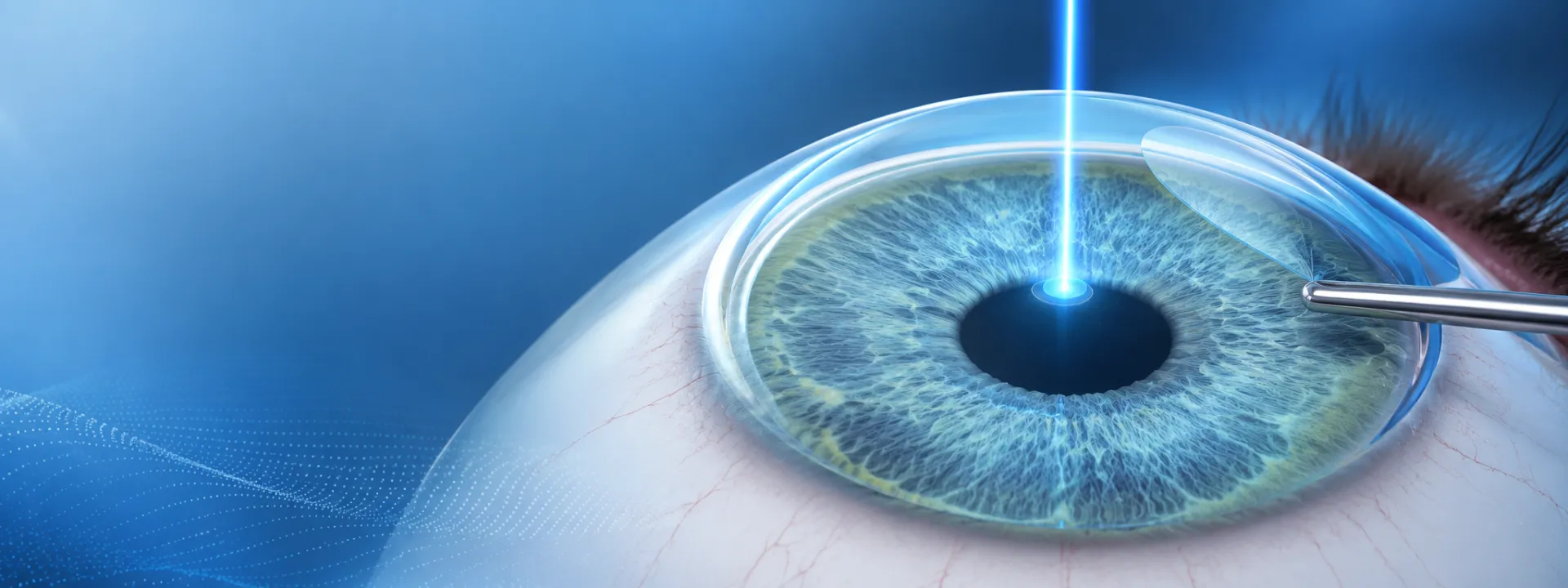
When looking into refractive surgery, you quickly come across a wide range of terms: PRK, LASEK, TransPRK, LASIK, FemtoLASIK, SMILE…
This diversity can give the impression that there are many very different techniques.
Things are simpler: these names correspond to variations, technological evolutions, or commercial branding derived from three main treatment approaches.
The aim of this article is to help you make sense of it all.
Three main treatment techniques
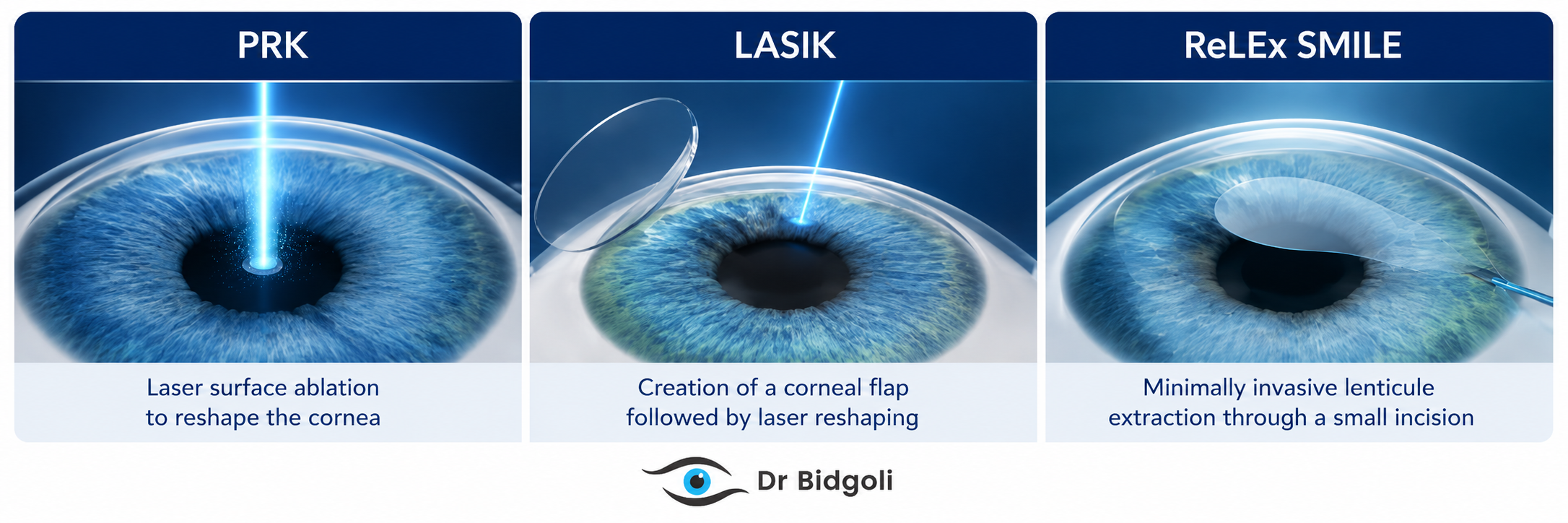
Laser refractive surgery is essentially based on three approaches:
- Surface treatment (PRK-type, without creating a flap)
👉 Correction is performed directly on the surface of the cornea - Flap-based treatment (LASIK-type)
👉 A thin layer of the cornea is lifted before treatment is performed deeper within the cornea - Lenticule extraction techniques (SMILE-type)
👉 A small lenticule is cut within the cornea and then removed through a small incision
PRK, LASEK, ASA, TransPRK, Epi-LASIK: variations of the same technique
PRK (Photorefractive Keratectomy) is the historical surface treatment technique.
Its principle is simple:
- the epithelium (the superficial layer of the cornea) is removed, either mechanically or using an alcohol solution
- vision is then corrected using an excimer laser
Over time, several variations have emerged:
- LASEK: the epithelium is loosened using alcohol and then repositioned → in practice, repositioning does not provide significant benefit, and this technique is now much less commonly used
- Epi-LASIK: epithelial separation using a mechanical blade followed by repositioning → again, little demonstrated benefit compared to other surface techniques
- ASA (Advanced Surface Ablation): a more “modern” term, but with the same principle
- TransPRK: the laser removes the epithelium directly without mechanical contact
👉 In practice, I use the term PRK for simplicity.
However, when possible (in most cases), I prefer TransPRK, which allows a contact-free procedure, a simplified operation, faster recovery, and generally reduced post-operative discomfort.
LASIK and FemtoLASIK: flap-based treatment
LASIK (Laser-Assisted in Situ Keratomileusis) consists of creating a thin corneal flap, then applying the same excimer laser deeper within the cornea before repositioning the flap.
There are two ways to create this flap:
- “Classic” LASIK: using a mechanical blade. This technique is now used much less frequently, as it is less precise and associated with more complications.
- FemtoLASIK: using a femtosecond laser. This laser creates the flap, which is then lifted manually, and the excimer laser is applied inside (in situ) the cornea. FemtoLASIK is widely preferred because it is more precise and reproducible.
👉 For simplicity, I refer to LASIK, although in practice it is exclusively FemtoLASIK.
SMILE, KLEX and others: new techniques or marketing?
SMILE (Small Incision Lenticule Extraction) is a more recent technique:
- a lenticule is created within the cornea
- it is then removed through a small incision
The term SMILE (formerly ReLEx SMILE) is associated with technology developed by Carl Zeiss (the laser manufacturer).
Other names such as KLEX, SmartSight, or CLEAR correspond to variations offered by other manufacturers. SMILE Pro is an evolution of SMILE performed with the newer VisuMax 800 laser instead of the previous VisuMax 500.
Why so many names?
Several reasons explain this proliferation:
- technological evolution
- differences between manufacturers
- marketing strategies aimed at differentiating techniques
👉 The result: multiple names for very similar principles.
It is worth noting that other terms such as “customized treatment,” “topography-guided,” or “wavefront-guided” do not refer to surgical techniques, but rather to different ways of programming the laser treatment. These will be covered in a dedicated article.
What really matters
Beyond the names, the key point is that there are:
- surface techniques (PRK / TransPRK type)
- flap-based techniques (FemtoLASIK type)
- lenticule extraction techniques (SMILE type)
👉 The choice depends on your eye, your prescription, and a personalized assessment.
In practice
The role of the ophthalmologist is to propose the most appropriate technique for your situation, based on a detailed analysis of your cornea and visual needs.
👉 Understanding the terminology is useful, but choosing the right indication is essential.